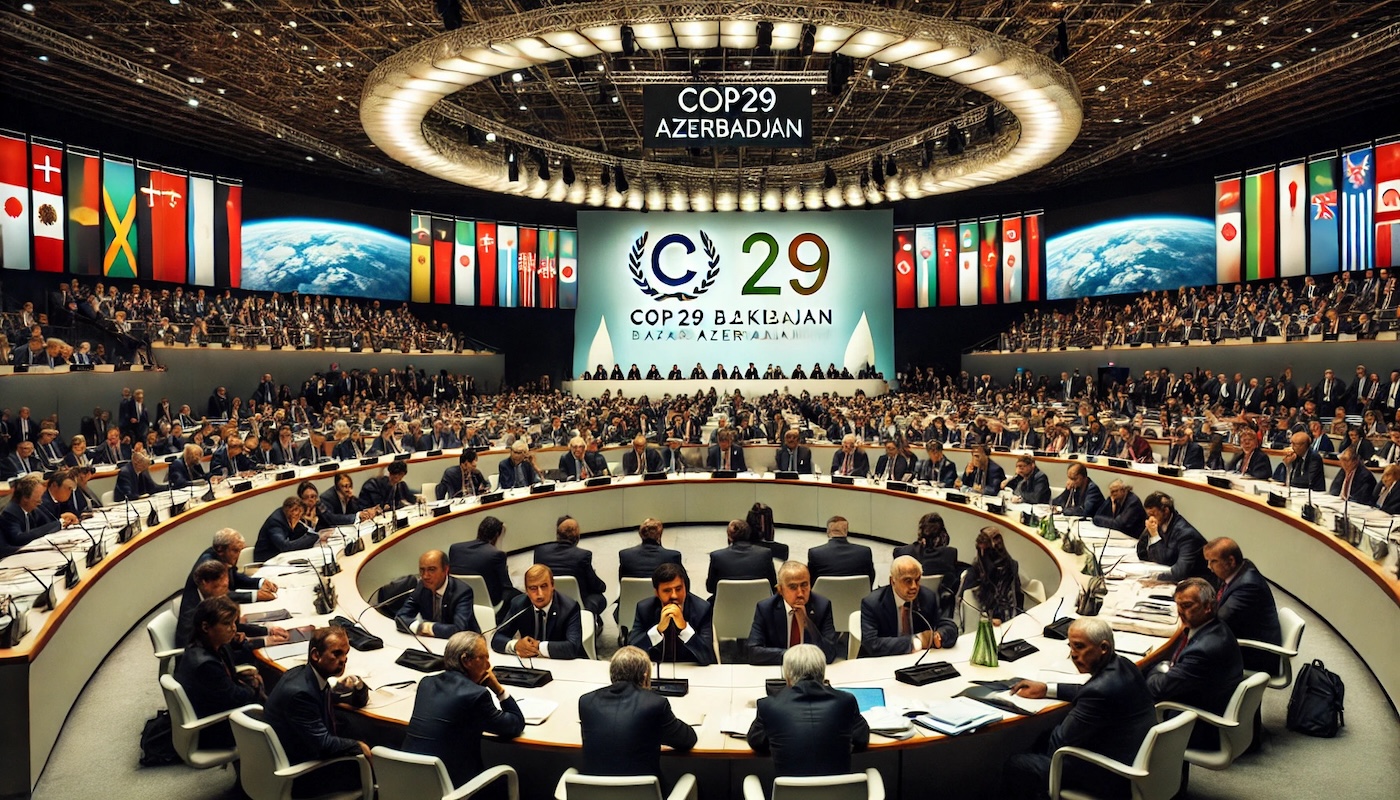
The 29th United Nations Climate Change Conference, COP29, ended on November 24 in Baku, Azerbaijan, with landmark developments pertaining to the financing of climate action and mechanisms involving carbon markets. Close to 200 countries attended the conference, which achieved two important agreements on:
- Establishing new climate finance targets to be reached by 2035.
- Operationalizing and nearly completing the general alignment on Article 6 of the Paris Agreement.
These two advancements both hold promise and uncertainties regarding their implications for carbon markets.
Outcome #1 – Adoption of a New Collective Quantified Goal:
COP29 carried significant weight as it coincided with the urgent 2024 deadline for setting a new global finance target to support climate action. From the outset, discussions revolved around the scale, structure and accessibility to the new financing mechanisms and targets to be implemented.
After intense negotiations, opposing mainly the countries appearing in Annex II of the UNFCCC (i.e. developed countries) and developing countries, nations reached a consensus and adopted two ambitious finance targets designed to accelerate global climate action:
- A call to “all actors” to increase investment in climate finance across all sources (public, private, and multilateral) to reach “at least” $1.3 trillion annually by 2035.
- A specific commitment of $300 billion annually from developed countries, focusing on public or private finance leveraged by public funds.
This last goal of $300 billion that falls within the more ambitious $1.3 trillion goal, has been termed the New Collective Quantified Goal, NCQG. It replaces an earlier $100 billion a year target, which developed nations had promised to mobilize from 2020 to 2025.
The NCQG represents an effort to reaffirm and expand solidarity with developing nations affected by climate disasters and allow new opportunities for the voluntary carbon markets in the developing countries. To achieve this, it calls for greater mobilization from bilateral donors (e.g., development agencies like AFD in France), multilateral development banks, and potential new funding sources, such as global solidarity contributions. Notably, the NCQG also envisions voluntary contributions from developing countries with sufficient capacity, particularly through their shareholding in multilateral development banks or bilateral financing efforts.
However, and while the NCQG is an improvement over earlier pledges, it falls short of the demands made by developing countries, who insisted on $1.3 trillion annually exclusively from developed nations. The broader 1.3$ objective agreed during COP29 distributes responsibility among « all actors, » raising questions about the adequacy and predictability of funding flows.
Outcome #2 – Article 6 implementation finalized
After nearly a decade of negotiations, COP29 achieved a breakthrough in finalizing the rules governing carbon trading under Article 6 of the Paris Agreement, an article that facilitates international cooperation by allowing countries to meet their climate targets through market-based trading mechanisms.
COP29 finalized rules for both:
- Article 6.2, which governs country-to-country trading of GHG emission reductions (referred to as « mitigation outcomes »).
- Article 6.4, which establishes a centralized international carbon market under UN supervision.
On country-to-country trading (Article 6.2 mechanism), COP29 introduced new clarity on the process of how nations will authorize carbon credit exchanges and manage registries to ensure transparency and integrity of credits and related transactions.
New guidelines standardize authorization statements, supported by a voluntary UNFCCC Letter of Authorization (LoA) template that will also define terms for changes and revocation, enhancing risk mitigation for buyers, especially in aviation, where adjustments are mandatory under CORSIA. The list of LoAs will also be made publicly available on an UNFCCC registry, allowing for greater transparency. Automated checks and technical expert review will be public if inconsistencies are “significant” or “persistent”. However, Buyer countries are only “requested” to not use credits from agreements with identified issues and Seller countries only need to make “reasonable efforts” to resolve issues “as soon as possible”.
In parallel with Article 6.2 alignment, nations reached a consensus on creating a new high-level centralized carbon market under Article 6.4, known as the Paris Agreement Credit Mechanism (PACM – the new Clean Development Mechanism (CDM)). This market, separate from the traditional VCM, aims to implicitly establish a minimum quality standard (broadly aligned with the ICVCM Core Carbon Principles) by introducing stricter safeguards compared to previous or existing systems, including:
- A mandatory sustainable development tool, ensuring projects meet environmental and human rights safeguards.
- Stricter science-based baselines, preventing over-crediting and ensuring projects achieve real emission reductions.
- Additionality checks, avoiding credits for projects that would have occurred without external financing.
- Specific requirements for carbon removals
- Appeals and Grievance Procedures
While this is a positive step for developing nations—promising new financial flows and capacity-building support—full operationalization of the PACM is still pending. Before credits can be traded, specific methodologies must be approved, and projects must be registered. This process is expected to take at least a year.

Unlocking the potential of voluntary carbon markets
After several weeks of discussions, COP29 has laid the foundation for a hopefully transformative decade for climate, especially thanks to climate finance and carbon markets, with carbon markets positioned as crucial to global decarbonization efforts. While the increase in global financial effort towards climate reinforces solidarity with developing countries despite likely insufficient ambition, the general alignment around Article 6 creates the promise of a redefinition of the landscape of carbon markets, boosting the confidence in its ability to act as a strong lever for decarbonization.
Article written by :

Carbon Project Developer